
The Renal Medicine Portfolio Pathway: Your Route to the Specialist Register
What actually has to be in your ePortfolio before the GMC will add your name — broken down from the JRCPTB 2022 curriculum.
Every renal trainee eventually asks the same question: what do I actually need to tick off before I can apply for a CCT? The curriculum document runs to almost sixty pages, so here’s the short version — the mandatory evidence, exams, and sign-offs that sit behind the entry on the specialist register.
The shape of training
Renal Medicine is a “dual CCT” specialty. You train in Renal Medicine and General/Internal Medicine (GIM/IM) side by side, over an indicative four years of higher specialty training (ST4–ST7), after completing IM stage 1 or ACCS-IM. At the end, you need two CCTs, not one — and both draw on the same portfolio.
The three tiers of capabilities you must clear
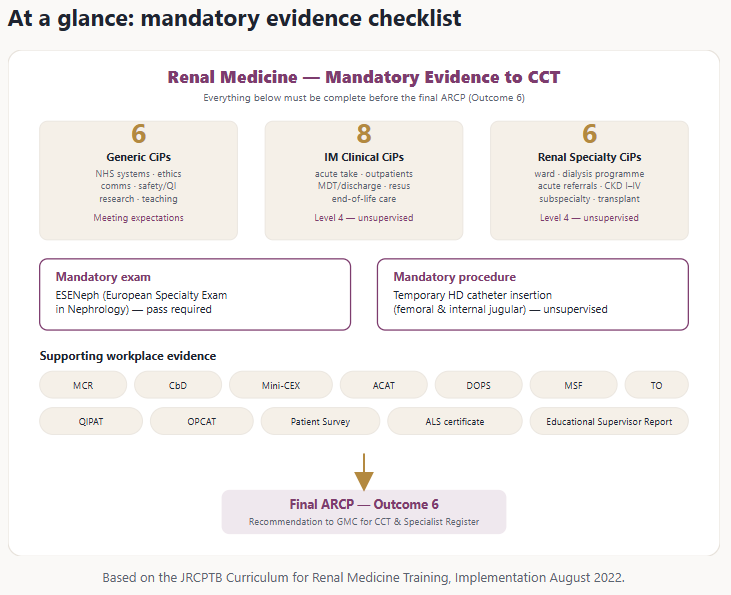
Everything in the portfolio maps back to three sets of Capabilities in Practice (CiPs). To reach CCT, every one of these must be signed off at Level 4 — entrusted to act unsupervised:
- 6 generic CiPs — NHS systems, ethics and law, communication, patient safety and QI, research, teaching
- 8 Internal Medicine clinical CiPs — acute take, specialty acute care, inpatient continuity, outpatients, cross-specialty problems, MDT/discharge, resuscitation, end-of-life care
- 6 Renal Medicine specialty CiPs — running a renal ward, dialysis programme management, acute renal referrals, CKD stages I–IV, a subspecialty service, transplant patients
The mandatory exam: ESENeph
On top of the MRCP(UK) diploma you’ll already hold from IM stage 1, Renal Medicine has its own summative knowledge exam — the European Specialty Examination in Nephrology (ESENeph), run jointly with the British Renal Society. A pass is mandatory; workplace assessment alone is not enough to reach CCT without it.
The one mandatory procedure
Renal Medicine has a single specialty-specific procedural requirement: insertion of temporary (non-tunnelled) haemodialysis catheters, in both the femoral and internal jugular routes. You need to be signed off as able to perform this unsupervised — expected by the end of ST4 — assessed via DOPS. Tunnelled lines, native/transplant kidney biopsy and PD catheter placement are recommended but not mandatory.
The evidence that feeds every decision
None of the above gets signed off in isolation. Your Educational Supervisor builds their annual report from a basket of workplace-based assessments, and the ARCP panel makes the final call from that report plus your ePortfolio evidence. The building blocks are:
| Evidence type | What it’s for |
|---|---|
| Multiple Consultant Report (MCR) | Longitudinal supervisor feedback — feeds almost every CiP |
| Case-based Discussion (CbD) | Clinical reasoning & decision-making from real case notes |
| Mini-CEX | Observed clinical encounters — history, exam, reasoning |
| ACAT | Performance on the acute take |
| DOPS | Procedural competence (summative for the HD catheter) |
| Multi-Source Feedback (MSF) | 360° view of communication, teamwork, professionalism |
| QIPAT | Quality improvement project assessment |
| OPCAT / Patient Survey | Outpatient consultation quality |
| Teaching Observation (TO) | Competence as a clinical teacher |
| ALS certificate | Mandatory for resuscitation CiP, kept current |
Worth knowing: once a CiP or procedure is signed off at the top level, you don’t need to keep re-proving it — unless you or your supervisor have a reason to revisit it. The system is built to avoid duplicated assessment.
The finish line
The critical progression point is the final ARCP. To get Outcome 6 and be recommended for CCT, you need Level 4 entrustment across all 20 CiPs (generic, IM clinical and renal specialty), a pass in ESENeph, your ALS certificate current, and the mandatory procedure signed off. JRCPTB recommends an external review of outstanding gaps around 12–18 months before your expected CCT date — that’s the point to chase down anything still missing.